
An academic degree awarded by a university is a formal qualification granted after a student successfully completes a defined program of higher education. These degrees usually mark different academic levels, from undergraduate study to advanced graduate and doctoral pathways.
Table of Contents
TL;DR
A university-awarded academic degree is a formal higher-education credential granted after completing an approved program of study.
The most common degree levels are associate, bachelor’s, master’s, specialist, and doctorate.
A degree is a different academic award from a certificate or short postsecondary program.
Universities confer degrees after students complete academic, credit, and graduation requirements.
Table of Contents
What is an academic degree awarded by a university?
An academic degree awarded by a university is a formal educational qualification granted after a student completes a recognized program of higher education. It confirms that the student has met the academic standards and program requirements established by the institution.
In simple terms, a university degree is more than attendance. It represents the successful completion of structured study at a specific academic level, such as undergraduate or graduate education.
Simple definition: a university-awarded academic degree is the official qualification a student receives after finishing a higher-education program and meeting graduation rules.
Is a degree the same as a certificate?
No. A degree and a certificate are not the same type of academic award. A degree usually represents a broader and more structured level of higher education, while a certificate usually confirms completion of a shorter or more targeted postsecondary program.
This distinction matters because many students search for university credentials without realizing that not every academic award is a degree. Some programs end with certificates, while others lead to full degree qualifications.
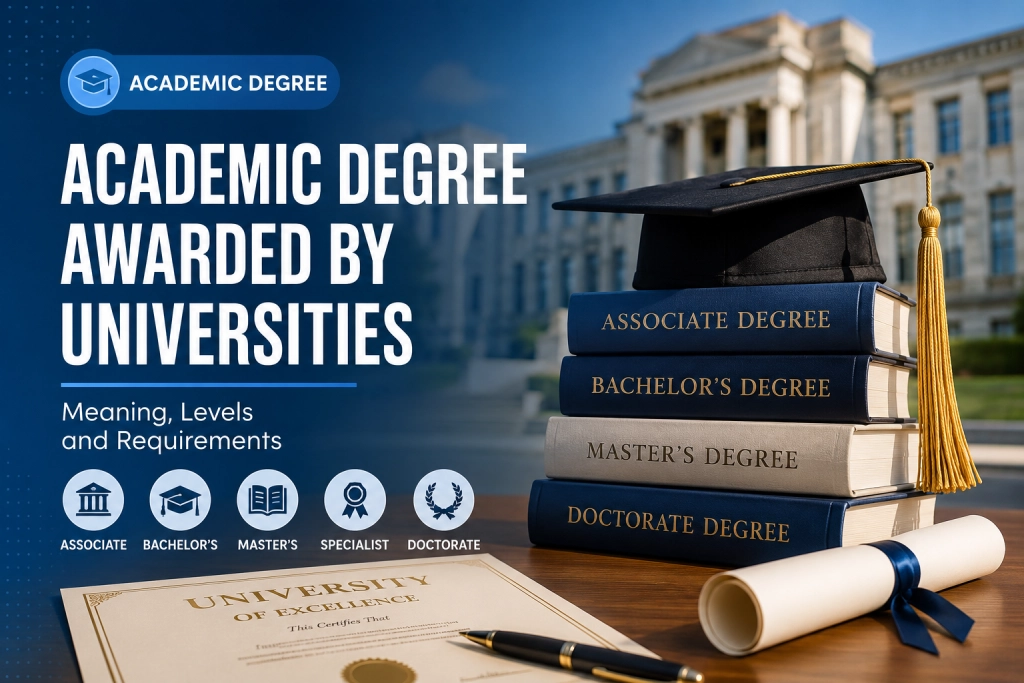
What are the main degree levels universities award?
Associate
A shorter undergraduate degree that often requires about two years of full-time study.
Bachelor’s
The standard undergraduate university degree in many systems, often around four years.
Master’s
A graduate degree usually completed after the bachelor’s degree.
Specialist
An advanced postgraduate credential found mainly in selected professional fields.
Doctorate
The highest academic degree level in most systems.
Associate and bachelor’s degrees
At the undergraduate level, universities and colleges commonly award associate and bachelor’s degrees. The associate degree is a sub-baccalaureate qualification, while the bachelor’s degree is a baccalaureate-level qualification and is usually longer and more advanced.
For many students, these are the first major higher-education credentials. The associate degree may support transfer or workforce entry, while the bachelor’s degree often serves as both a career credential and the normal gateway to graduate study.
Master’s, specialist, and doctorate degrees
At the graduate and postgraduate level, universities may award master’s, specialist, and doctorate degrees. A master’s degree usually builds on the bachelor’s degree and offers more advanced and specialized study.
The specialist degree is a more specific advanced credential, especially in fields such as education. The doctorate is usually the highest academic degree level and may focus on research, advanced professional practice, or both depending on the program.
How do universities award degrees?
Universities award degrees after a student completes an approved program of study and satisfies the institution’s graduation rules. This usually includes earning the required credits, completing the required courses, meeting academic standards, and successfully finishing any final capstone, research, internship, clinical, or dissertation requirements that apply.
The exact process depends on the institution and country, but the basic idea is the same: the university does not award the degree simply because a student enrolled. The degree is conferred after all formal requirements are completed and verified.
What graduation requirements do students usually complete?
Graduation requirements vary, but most university degrees involve a combination of required coursework, credit completion, minimum academic performance, and successful completion of any final program components. In some programs, this may include projects, internships, supervised practice, comprehensive exams, or a dissertation.
That is why university degrees should be seen as earned academic milestones. They reflect both time spent studying and the successful completion of the program’s formal academic expectations.
What does a university-awarded degree represent?
A university-awarded degree represents academic achievement at a defined level of higher education. It signals that the student has met the learning objectives and formal standards of an institution recognized to offer that credential.
Depending on the degree level, it may also support career entry, professional advancement, graduate study, research training, or leadership development.
Final verdict
An academic degree awarded by a university is not just a document. It is the formal recognition that a student has completed a structured higher-education program at a specific academic level.
Related degree guides
University degree FAQs
What is an academic degree awarded by a university?
It is a formal higher-education qualification granted after a student completes a recognized university program and satisfies the graduation requirements.
What degree levels do universities usually award?
The most common levels are associate, bachelor’s, master’s, specialist, and doctorate.
Is a certificate the same as a degree?
No. A certificate is a different type of postsecondary award and is not the same as a degree.
How do universities award degrees?
Universities award degrees after students complete the required credits, courses, academic standards, and any final program requirements that apply.
What is the difference between a bachelor’s and a master’s degree?
A bachelor’s degree is an undergraduate degree, while a master’s degree is a more advanced graduate degree usually completed after the bachelor’s level.
Is a doctorate the highest university degree?
Yes. In most academic systems, the doctorate is the highest academic degree level.
 Unleashing Your Creative Potential: The Benefits of Pursuing a Master of Fine Arts Degree
 Unlocking Career Opportunities with a Masters in Law Degree
 American Degree Transfer Program: Your Path to Success in US Universities
 Discover the Charm of OSU Stillwater: A Hidden Gem in America’s Heartland
 Online Programs for Bachelor’s Degree: Explore Convenient and Quality Higher Education Options