
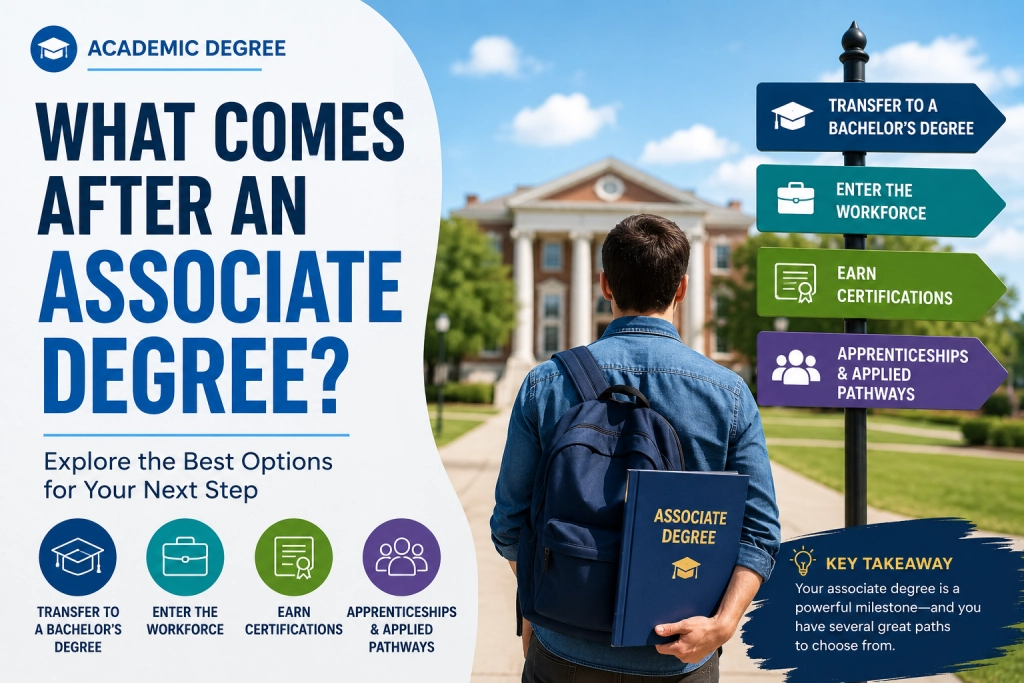
After an associate degree, students usually choose between continuing to a bachelor’s degree, entering the workforce, earning industry certifications, or building experience through applied career pathways. The best option depends on your transfer plan, career goal, income needs, and how quickly you want to move forward.
Table of Contents
TL;DR
Many students continue into a bachelor’s degree after finishing an associate degree.
Some graduates enter the workforce directly and begin building experience right away.
Certifications, licenses, and applied training can strengthen your employability after graduation.
If you want to transfer, always check how your credits will apply before choosing your next program.
Table of Contents
What comes after an associate degree?
The short answer is that there is no single next step for everyone. After an associate degree, many students transfer into a bachelor’s program, while others start working, earn a certification, or move into a more applied training route.
The smartest next move depends on your goal. If you want a four-year degree, you need a strong transfer plan. If you want to start earning sooner, direct employment or a job-focused credential may make more sense.
Simple answer: the most common paths after an associate degree are transfer, work, certifications, and applied career training.
Option 1: Transfer to a bachelor’s degree
For many graduates, the most natural next step is a bachelor’s degree. This path is especially common for students who completed an AA or AS and want to continue toward a four-year qualification.
However, transfer is not automatic in the same way everywhere. College Board advises students to choose courses strategically because not every credit from a two-year college will transfer to a four-year institution. In transfer-friendly systems, the outcome can be much better. For example, SUNY says students who graduate with an AA or AS and transfer to a parallel program at a SUNY four-year campus receive guaranteed junior standing. That shows why transfer planning matters so much before and during the associate degree.
Best fit if you want to:
- earn a bachelor’s degree faster and more affordably
- keep building toward graduate study later
- improve access to jobs that prefer a four-year degree
Option 2: Enter the workforce
Some associate degree graduates decide that the right next step is to start working right away. This is especially common after more applied or technical programs, including many AAS pathways.
This route can make sense if you want to begin earning sooner, gain practical experience, or test whether your field is the right fit before investing in more education. It can also work well when your program already aligns closely with local employers or specific occupational training.
Option 3: Add certifications or licenses
Another strong next move is to build on your associate degree with an industry certification or required license. CareerOneStop explains that certifications can help people enter or advance in many careers, which makes them especially useful after a shorter college credential.
This option works well for students in fields where employers value proof of technical skill, compliance, software knowledge, clinical readiness, or industry-standard competence. In some cases, certification can strengthen your resume even before you decide whether to continue to a bachelor’s degree.
Option 4: Consider apprenticeships and applied career pathways
If your priority is hands-on learning and paid experience, apprenticeships may be worth considering. The U.S. Department of Labor describes apprenticeships as programs that combine paid on-the-job training with classroom instruction to prepare workers for highly skilled careers.
This path can be especially attractive for students who prefer applied learning, want to avoid a purely classroom-based next step, or are entering a field where practical skill development matters more than collecting another degree immediately.
How to decide what to do next
A good decision usually comes down to four questions: Do you need a bachelor’s for your target job? Do your current credits transfer well? Do you need income soon? And would a certification or applied pathway move you forward faster than another degree right now?
Students who want long-term flexibility often lean toward transfer. Students who want immediate momentum often choose work, certifications, or apprenticeships first. Neither path is automatically better. The right choice is the one that fits your timeline and your career direction.
Choose transfer if…
you need a bachelor’s degree for your long-term goals and your credits fit well into a four-year pathway.
Choose work first if…
you want income sooner, already have job-ready skills, or need real-world experience before more study.
Choose certifications if…
you want a fast, targeted way to strengthen your value in a technical or regulated field.
Associate degree vs bachelor’s degree: why many students compare both
One reason students often continue after an associate degree is that they want to compare the longer-term value of a bachelor’s degree. BLS reported that in 2024, workers age 25 and over with an associate’s degree had median usual weekly earnings of $1,099 and an unemployment rate of 2.8%, while those with a bachelor’s degree had median weekly earnings of $1,543 and an unemployment rate of 2.5%.
That does not mean everyone should continue immediately. But it does explain why the bachelor’s pathway remains one of the most common options after an associate degree, especially for students thinking about long-term mobility, income growth, or graduate study later on.
Final verdict
After an associate degree, the best next step is usually one of four paths: transfer, work, certifications, or applied training. The right choice depends less on prestige and more on fit, credit transfer, timing, and career direction.
Related degree guides
FAQs about what comes after an associate degree
What comes after an associate degree?
The most common next steps are transferring to a bachelor’s degree, entering the workforce, earning certifications, or moving into an applied training path such as an apprenticeship.
Can you go from an associate degree to a bachelor’s degree?
Yes, often you can, but transfer rules vary by institution and program. Students should always verify how their credits will apply before choosing a transfer path.
Is it better to work after an associate degree or keep studying?
It depends on your goals. Working can bring income and experience sooner, while continuing to a bachelor’s degree may improve long-term flexibility and access to more roles.
Can certifications help after an associate degree?
Yes. Certifications can help you enter or advance in many careers, especially in technical or regulated fields.
Are apprenticeships a good next step after an associate degree?
They can be. Apprenticeships combine paid work with structured instruction and may be a strong option for students who want hands-on skill development.
Does a bachelor’s degree usually lead to better earnings than an associate degree?
On average, BLS reported higher median weekly earnings for bachelor’s degree holders than for associate degree holders in 2024, although outcomes vary by field, location, and experience.